Cross-
Cutting
Research Area
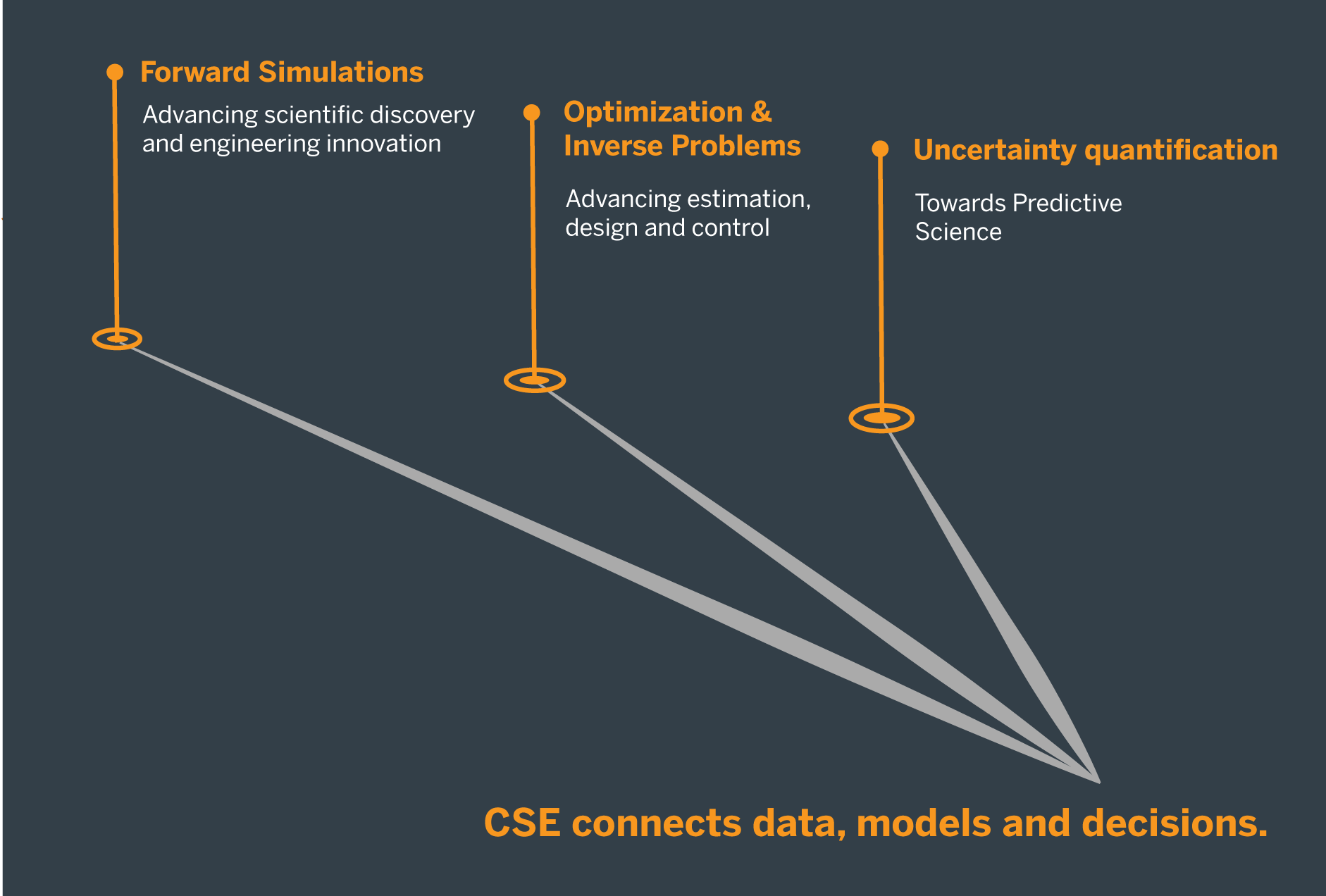
From forward simulation to the outer loop
Optimization, inversion and UQ bring the power of computational modeling to grand challenge problems that require estimation, design and control.
An Overview: Optimization, Inversion & Uncertainty Quantification
Why are optimization, inversion and UQ important?
Optimization, inversion and UQ are the key mathematical and computational tasks in what is often referred to as the “outer loop” (i.e., computational applications that form outer loops around a forward model).
Optimization A significant aspect of the field of CSE is the development of theory and methods for optimizing systems governed by large-scale CSE models, typically involving systems of ODEs or PDEs. Such problems are prevalent in applications of optimal control, optimal design and optimal experimental design.
Inversion In general, any endeavor to infer cause from effect — to extract knowledge from data — can be viewed as an inverse problem. Inverse problems sit at the heart of discovery and innovation in every area of science, engineering and medicine. As just a few examples of model-based inverse problems, we may infer: coalescing binary system properties from detected gravitational waves, earth structure from reflected seismic waves, reaction rates from measurements of chemically reacting flows, ice sheet basal friction from satellite observations of surface flow, and three-dimensional bone structure from X-ray computed tomography measurements.


Bayesian Inversion for Oil Spills: Developing a framework to pinpoint the origin of oil spills by constructing a probability distribution of where the origin may be located. Above: a simulation of the Deepwater Horizon oil spill using a newly developed particle tracking code.
Uncertainty quantification (UQ) involves the quantitative characterization and management of uncertainty in a broad range of applications. It employs both computational models and observational data, together with theoretical analysis. UQ encompasses many different tasks, including uncertainty propagation, sensitivity analysis, statistical inference and model calibration, decision making under uncertainty, experimental design and model validation.

Centers and Groups
To learn more about projects and people in Optimization, Inversion and UQ, explore the centers and groups with research activities in this cross-cutting research area.
Optimization, Inversion, Machine Learning, and Uncertainty for Complex Systems
Center for Subsurface Modeling
Computational Research in Ice and Ocean Systems Group
Electromagnetics and Acoustics Group
Parallel Algorithms for Data Analysis and Simulation Group
Predictive Engineering and Computational Sciences
Probabilistic and High Order Inference, Computation, Estimation, and Simulation
News in brief
News
Sept. 7, 2026
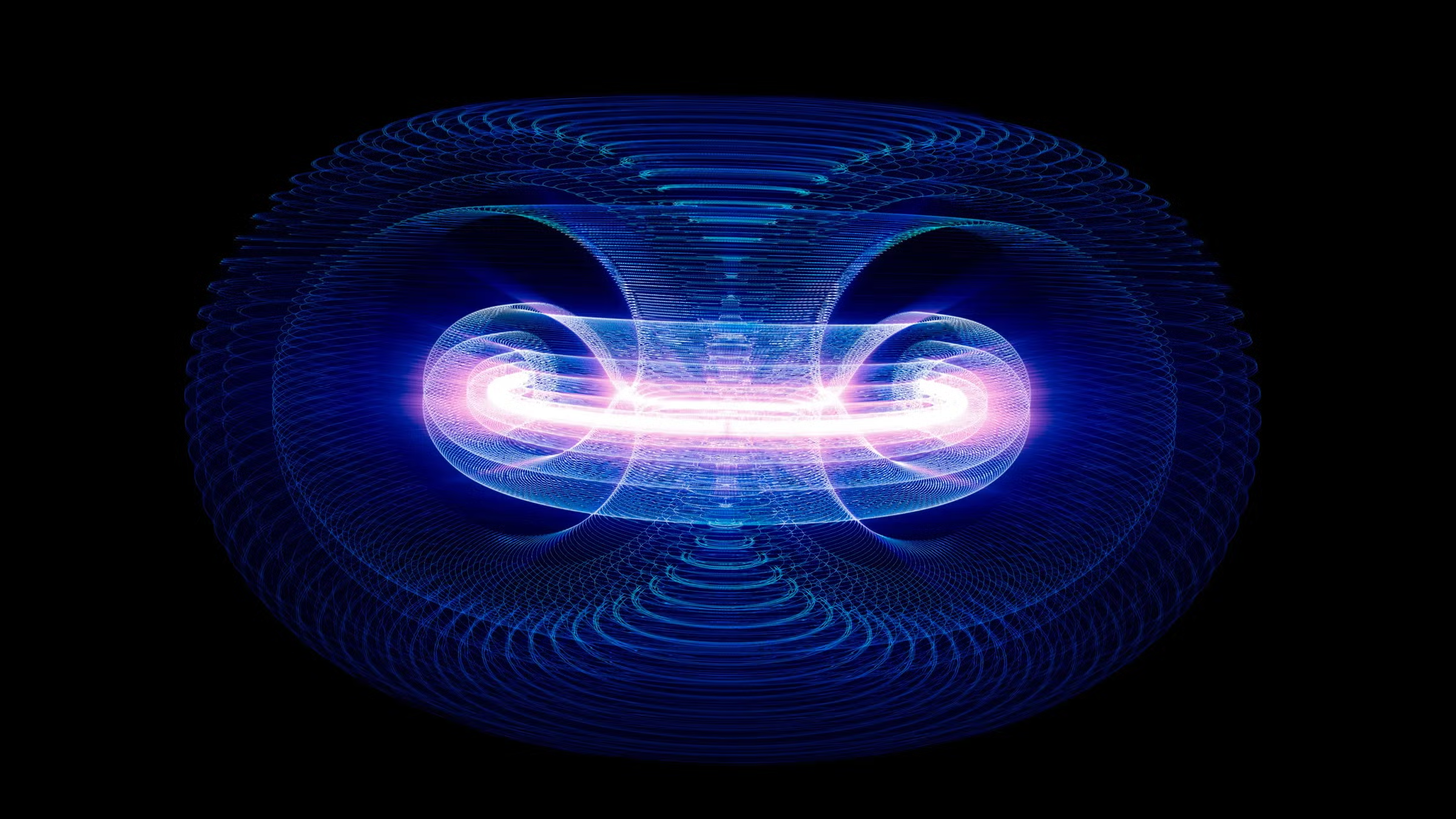
Fusion Energy Seed Grants Launch New Interdisciplinary Collaborations at UT Austin
Faculty at UT Austin have been awarded seed grants to unite fusion physicists, engineers and computational scientists while training graduate students for careers in fusion energy. The projects will develop faster, AI-assisted tools for plasma control, liquid-metal reactor materials, magnetic confinement and plasma-edge simulations.
Profile
May 7, 2026
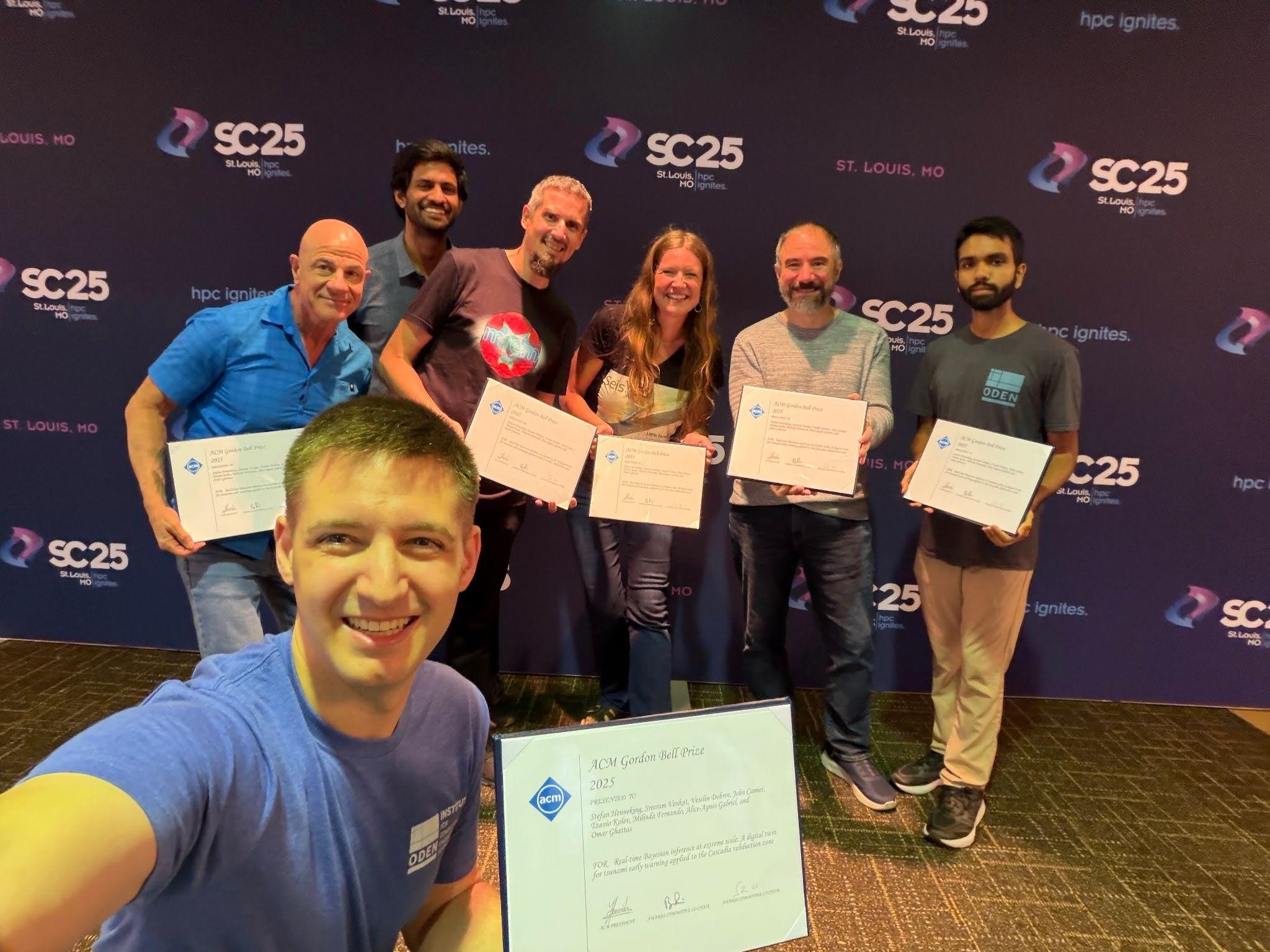
The Gordon Bell Prize and the Future of Tsunami Early Warning - Profile Stefan Henneking
Research Associate Stefan Henneking has spent his career on foundations in computation and applied mathematics with an eye toward real-world stakes. Last year landed him on the winning team for the Gordon Bell Prize in November 2025, awarded by the Association of Computing Machinery (ACM).
News
May 1, 2026
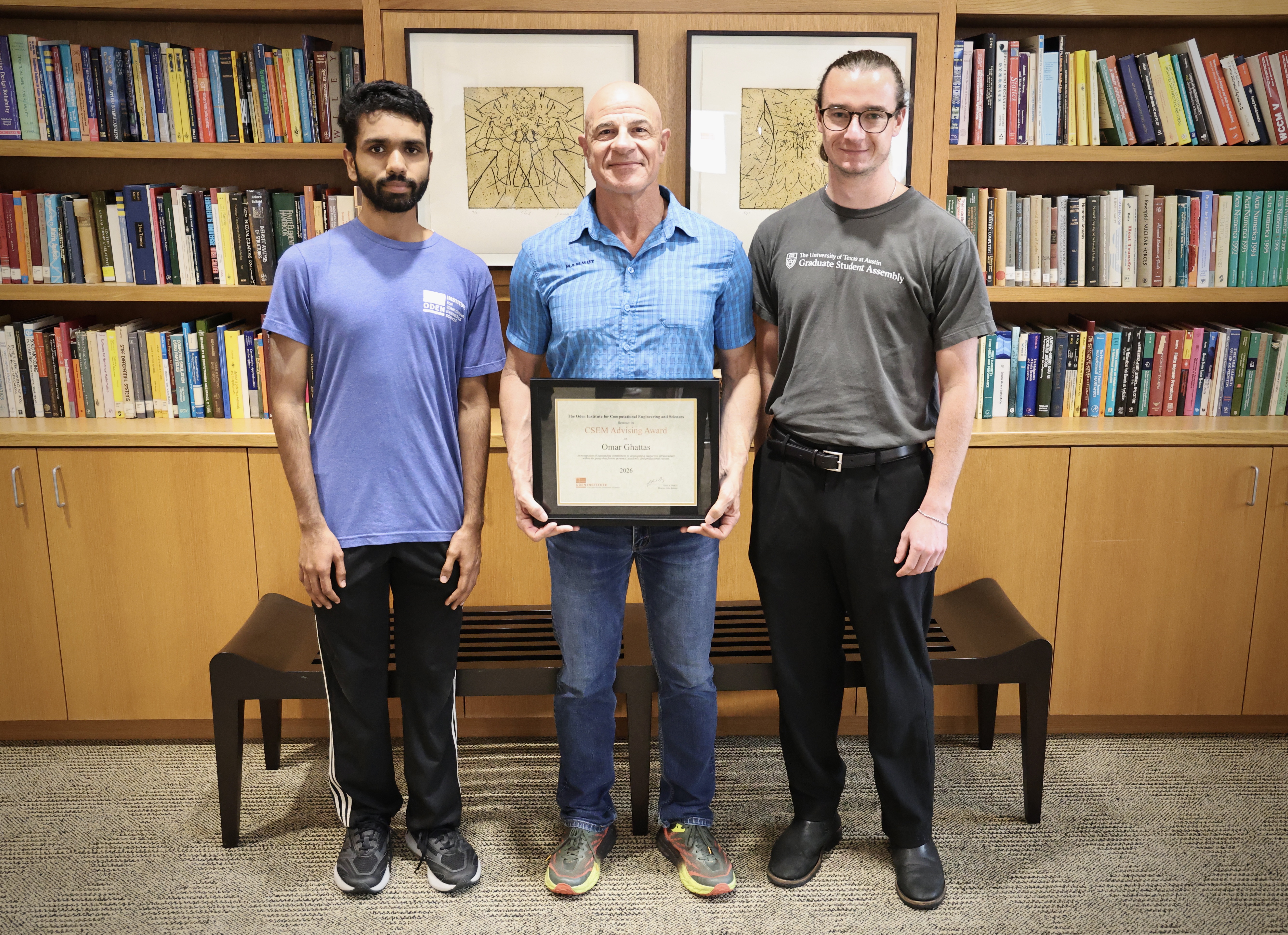
Omar Ghattas Receives CSEM Faculty Advising Award
Omar Ghattas was selected by a student committee as this year's recipient of the Oden Institute CSEM Faculty Advising Award for his exceptional commitment to mentoring and developing students.