Cross-
Cutting
Research Area
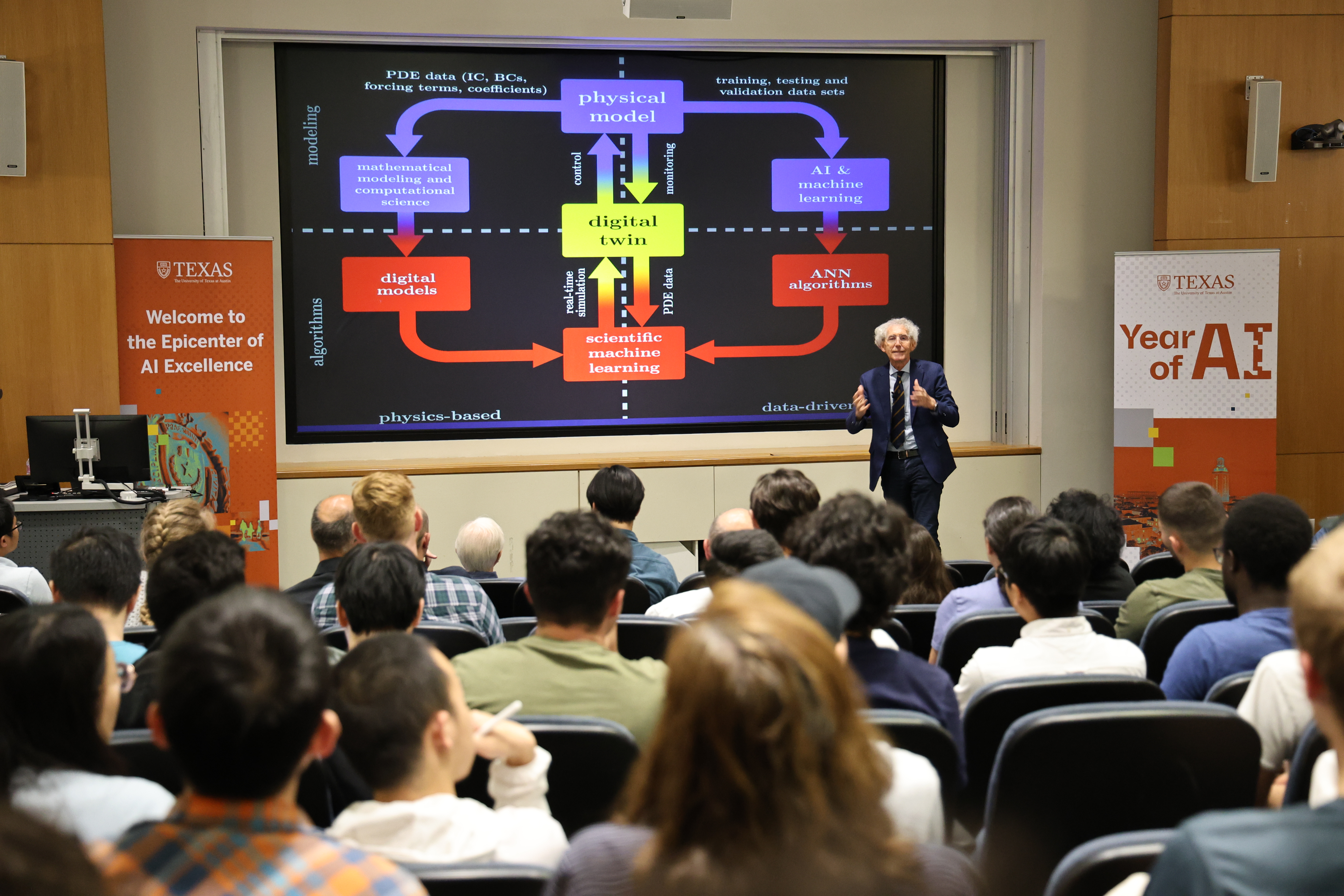
AI for Science is transforming science and engineering
Artificial Intelligence for Science
NSF-Simons AI Institute for Cosmic Origins
CosmicAI develops transformative AI methods to meet pressing astronomical challenges and tackle outstanding questions about our cosmic origins. Research spans four fundamental AI themes: trustworthiness, efficiency, interpretability, and robustness.
Led out of the Oden Institute, CosmicAI aims to serve as a nexus of collaboration to increase the accessibility of astronomy and AI data and methods through open-source AI-powered tools, data sharing, and AI educational initiatives.
AI-Accelerated Computational Science
Machine learning surrogates of computational science models are a key pillar of AI for Science, providing rapid simulation capabilities that enable uncertainty quantification, optimal design, autonomous experimental design, and inverse problems. The Oden Institute is at the forefront of developing the theory and algorithms for machine learning surrogates, as well as their integration in large-scale challenging applications across science and engineering.
Selected Projects
Co-Design of Neural Operators and Stochastic Optimization Algorithms for Learning Surrogates for PDE-Constrained Optimization Under Uncertainty
National Science Foundation, Division of Mathematical Sciences
PIs: Bollapragada, Ghattas, O'Leary-Roseberry
The Best of Both Worlds: Deep Neural Operators as Preconditioners for Physics-Based Forward and Inverse Problems
National Science Foundation, Office of Advanced Cyberinfrastructure
PIs: Ghattas, O'Leary-Roseberry
A Bayesian Inference Framework for Learning Earthquake Cycle Deformation Processes Across Scales via Novel Neural Operators
National Science Foundation, Directorate for Geosciences
PIs: Ghattas, Becker, O'Leary-Roseberry
Stochastic Twinning Space (STS) Transformations for Improving Real-time Digital Twin Accuracy
DARPA Defense Sciences Office, The Right Space Program
PIs: Willcox, Chaudhuri, Ghattas, Peherstorfer, Sarkar
Digital Twins
Digital twins are a key pillar of AI for Science, providing a mechanism for bi-directional interactions between the virtual and physical worlds and revolutionizing decision-making for complex physical systems. The Oden Institute is leading research to advance the science and application impact of digital twins.
Our work is establishing digital twin mathematical and computational foundations, including scalable methods for data assimilation, inverse problems, decision-making and control, and new approaches to address digital twin verification, validation and uncertainty quantification. Our work is advancing digital twin applications across multiple domains of science, engineering and medicine.
Selected Projects

M2dt: Multifaceted Mathematics for Predictive Digital Twins
A U.S. Department of Energy Mathematical Multifaceted Integrated Capability Center
PIs: Ghattas, Willcox, Biros, Heimbach, Lu, Ward
Collaborating Institutions: Massachusetts Institute of Technology, Sandia National Laboratories, Brookhaven National Laboratory, Argonne National Laboratory
Mathematical and Computational Foundations for Predictive Digital Twins
U.S. Air Force Office of Scientific Research Multidisciplinary University Research Initiative (MURI) Program
PIs: Willcox, Ghattas
Collaborating Institutions: Stanford University, NYU Courant Institute, University of Chicago, University of Tennessee Knoxville
Digital Twin Enabled Autonomous Control for On-Orbit Spacecraft Servicing
U.S. Space Force Space University Research Initiative (SURI) Program
PI: Willcox
Collaborating Institutions: UC Santa Cruz, University of Michigan

MuSiKAL: Multiphysics Simulations and Knowledge discovery through AI/ML technologies
U.S. Department of Energy, Advanced Scientific Computing Research (ASCR) Program
PIs: Dawson, Bui, Yang, Niyogi, Scanlon
How researchers develop digital twin-enhanced storm mitigation
A digital twin framework for developing and analyzing virtual patient cohorts to enable virtual clinical trials
NSF/NIH/FDA Foundations for Digital Twins as Catalyzers of Biomedical Technological Innovation (FDT-Biotech)
PIs: Hormuth, Chaudhuri, Kileel, Willcox, Yankeelov
Stochastic Twinning Space (STS) Transformations for Improving Real-time Digital Twin Accuracy
DARPA Defense Sciences Office, The Right Space Program
PIs: Willcox, Chaudhuri, Ghattas, Peherstorfer, Sarkar
Centers and Groups
To learn more about projects and people in Artificial Intelligence for Science, explore the centers and groups with research activities in this cross-cutting research area.
Optimization, Inversion, Machine Learning, and Uncertainty for Complex Systems
Center for Scientific Machine Learning
Jah Decision Intelligence Group
Computational Hydraulics Group
Computational Research in Ice and Ocean Systems Group
Parallel Algorithms for Data Analysis and Simulation Group
Computational Visualization Center
Probabilistic and High Order Inference, Computation, Estimation, and Simulation
Predictive Engineering and Computational Sciences
News in brief
News
Dec. 5, 2025
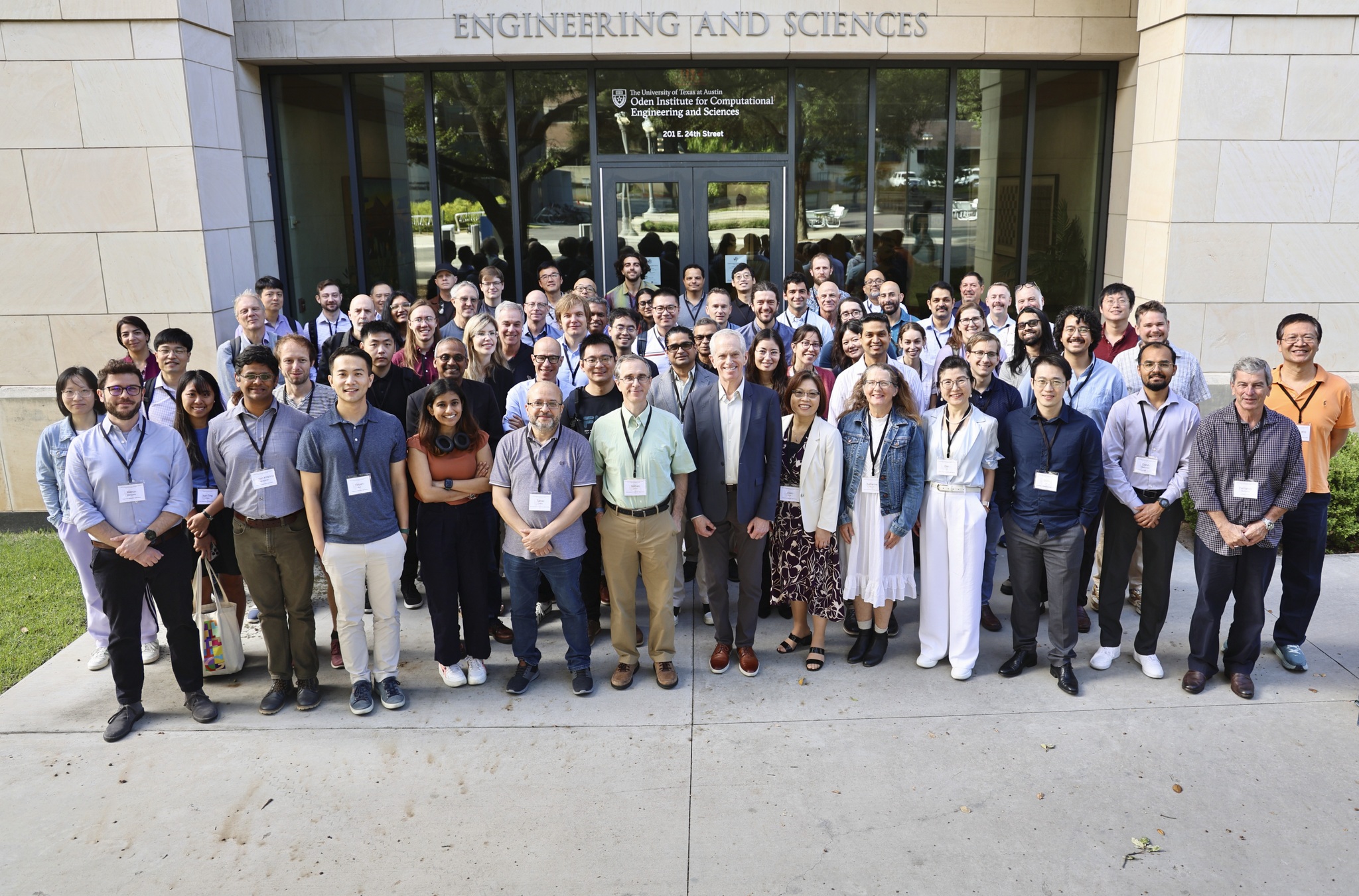
New Conference Brings Together Experts in AI and Digital Twin Modeling for Earth Systems
The AIDT4ES Workshop brought together nearly 100 experts to explore how artificial intelligence and digital twin technology can enhance Earth systems modeling. Researchers showcased innovations ranging from tsunami early warning systems to earthquake simulations and ocean-ice modeling.
Feature
Nov. 19, 2025
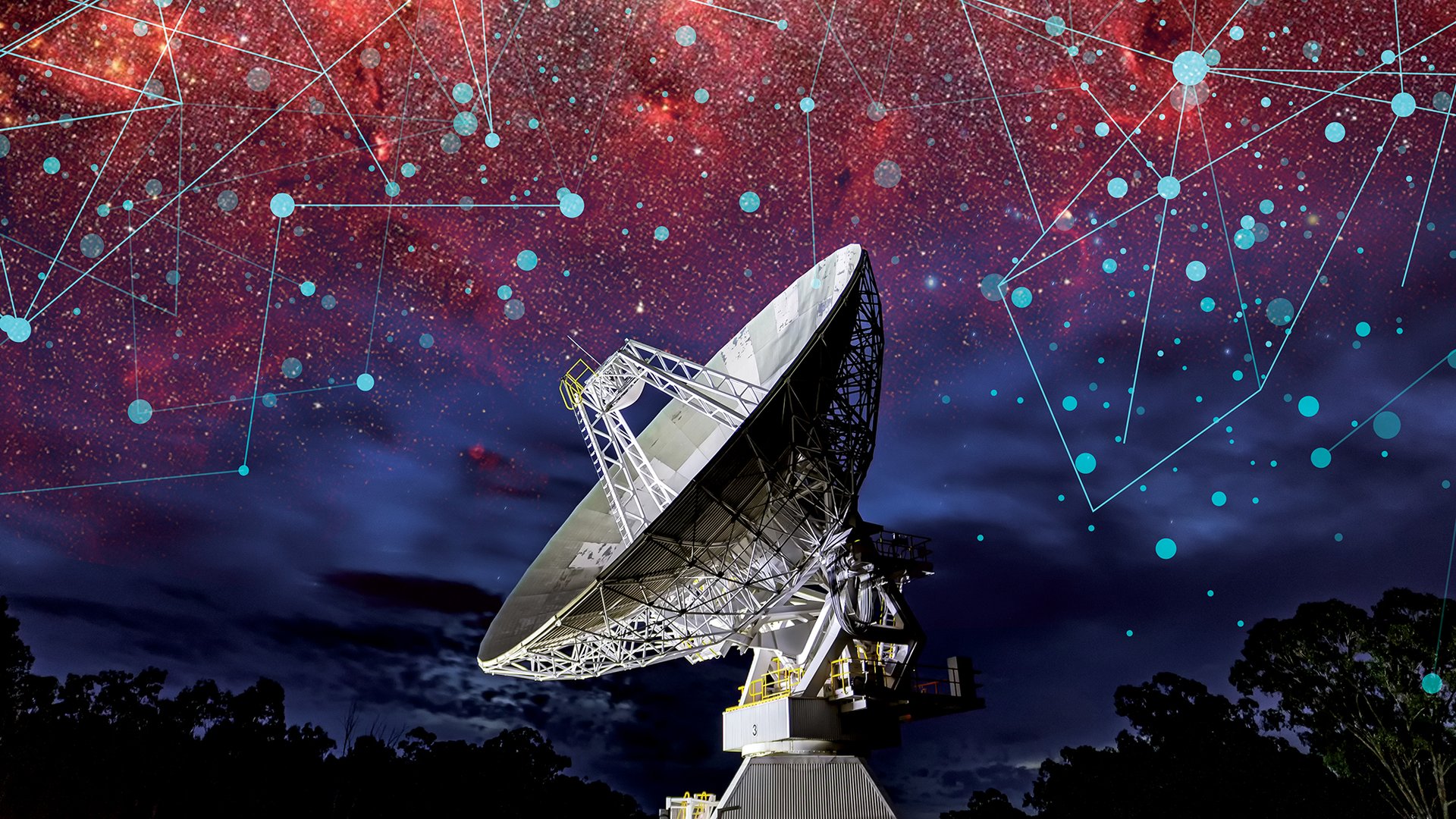
CosmicAI Institute Tackles Universe’s Deepest Mysteries
Astronomy is an excellent sandbox to develop AI techniques in a safe and open way. The NSF-Simon's CosmicAI Institute at UT's Oden Institute is an incubator for innovation and developing trust in AI to help researchers make new discoveries about the universe.
Media Coverage
Aug. 18, 2025
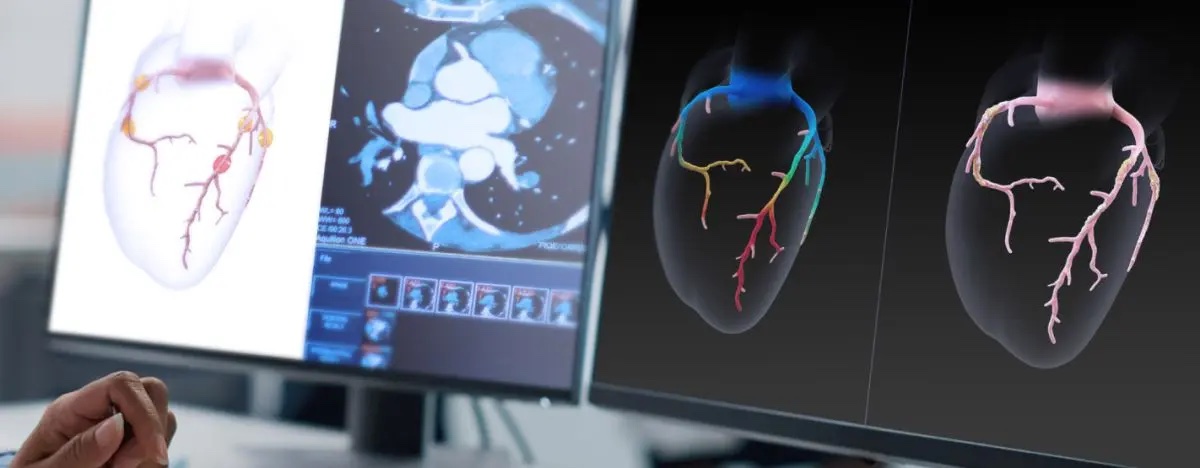
HeartFlow's AI-powered medical technology debuts on Nasdaq
Co-founded by NSF-funded researcher and UT faculty member Charles Taylor, HeartFlow is now a publicly traded company, offering its innovative solution for diagnosing coronary artery disease using AI and medical imaging