University of Texas at Austin

News

Crossing Boundaries: James Chelikowsky Reflects on Six Decades of Materials Science Discovery

Published July 20, 2026

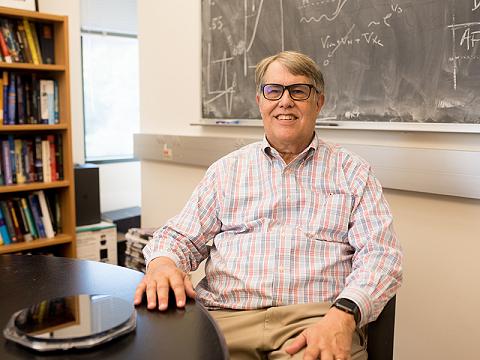
James Chelikowsky

University of Texas at Austin faculty James Chelikowsky once heard a Nobel Laureate describe how they stumbled into their biggest discovery. The lesson he took away was simple: breakthroughs rarely come to those who stay in their lane. It is a philosophy that has guided six decades of research crossing disciplinary boundaries in computational science, and one Chelikowsky finds himself thinking about now as he enters retirement. 

Professor of physics and chemical engineering and the W.A. "Tex" Moncrief, Jr. Chair of Computational Materials at the Oden Institute for Computational Engineering and Sciences where he leads the Center for Computational Materials, Chelikowsky has spent his career using computer modeling to predict the properties of materials before they are ever created in the laboratory.  

"I've been fortunate to work in a field that I enjoy," he said recently. That much is evident. His work has shaped how the field thinks about nanoscale materials, opened new frontiers in materials discovery using artificial intelligence, and helped establish computational approaches that are now standard across the discipline. 

Chelikowsky grew up in Manhattan, not the Big Apple of New York, but the "Little Apple," home to Kansas State University, where his father was a geology professor. Both Chelikowsky and his brother followed him there as a matter of course. Growing up in the 1950s, he watched one of the first satellites cross the night sky and felt the wave of scientific enthusiasm it ushered in. After exploring a range of sciences, he settled on physics, drawn both to its challenge and to the way it distinguished him from his engineer brother and geologist father. 

After graduating in 1970, he left Kansas for the first time, heading to the University of California, Berkeley, for graduate school. He arrived nervous, surrounded by students from renowned universities: California Institute of Technology, Harvard, Massachusetts Institute of Technology, and Yale. The anxiety did not last long. On his first quantum mechanics exam, he recognized a problem from his undergraduate coursework and earned the highest grade in the class. It would not be the only time. 

At Berkeley, he worked under Marvin Cohen, one of the world's most cited theoretical physicists and a foundational figure in computational physics. Chelikowsky went on to break the Berkeley record, at the time, for the most papers published during a single Ph.D. He reflects on what made that environment so productive. "It was very fortuitous because Marvin combined two things that were very appropriate for the time and place: he was one of the first people to use computational tools to examine and predict materials' properties, and he was very interested in semiconductors." 

The work they did together pushed the field in a new direction. Until then, semiconductor research was largely limited to crystalline materials, whose high symmetry made computation manageable. Cohen's group developed techniques that extended those methods to nonperiodic systems, materials without repeating structures. "That opened up a window to all sorts of materials, which heretofore nobody had done," Chelikowsky said. The hours he put in matched the ambition. He was regularly spotted in the computer room at three in the morning or on weekends. "I worked nearly every waking moment," he said. "And in turn, Cohen looked after me. He knew that if I did well, it helped him, and he also knew that it was his job to do the best he could in educating and placing his students." 
The most important advances come from new ideas, not just bigger computers or more data.

— Jim Chelikowsky

After completing his Ph.D., Chelikowsky began postdoctoral research at Bell Laboratories in New Jersey, then widely regarded as the greatest industrial research lab in the world, a place where Nobel Prizes were almost routine and foundational technologies were invented as a matter of course. For Chelikowsky, the prestige was not the point, and he realized a university environment might prove a better fit. 

He moved into academia, accepting a faculty position at the University of Oregon, but the gap in funding resources came as a shock. Before long, he moved back to industry, this time to Exxon, where he served as a group head in theoretical physics and chemistry from 1980 to 1987. The experience put him at the intersection of two very different scientific cultures. Physicists on one side studied pristine, controlled systems in ultra-high vacuum, chasing fundamental understanding. Chemists on the other hand often worked with complex, messy, real-world systems at high pressures. "From my perspective, both were right: the physicists for building basic understanding, and the chemists for focusing on what actually works," Chelikowsky said. He absorbed both ways of thinking into his research before moving back into academia. 

He landed next at the University of Minnesota, joining the Department of Chemical Engineering, where he would spend 17 years. Minnesota had a premier academic computing center and a collaborative culture that suited him. It was there that he found his footing as a mentor, modeling his advising approach on Cohen’s.  

"Marvin was one of the best people, both as a good scientist and knowing how to bring out the best in students," he said. Chelikowsky tried to do the same, encouraging students toward independence and teaching them not just how to solve problems but how to identify important questions, build collaborations, and navigate the profession. Over the course of his career, he has advised approximately 25 Ph.D. students and a similar number of postdocs through their research. Looking back, he says those two things, independence and professional formation, are what he most consistently got right.  

As formative as Cohen was, Chelikowsky is quick to acknowledge the many mentors, collaborators and students that both guided and supported his research — a reminder that he is a node in a much larger network of scientific influence that shaped his career. 

Jim came to UT to kick start the Institute's efforts in computational materials. In this he has been highly successful, both through his own well recognized research and through the talented faculty he has helped to attract. He is a valued colleague and a good friend.

— Robert Moser, Oden Institute deputy director

As his children moved out of the house, Chelikowsky was drawn to UT Austin in 2005, recruited by Tinsley Oden to join the then-named Institute for Computational Engineering and Sciences and attracted by UT’s growing computational facilities at the Texas Advanced Computing Center. He joined the Departments of Physics, Chemical Engineering and Chemistry, and became a principal faculty member at the Oden Institute. 

By the time he arrived at UT, Chelikowsky had already established himself as a pioneer in one of the most consequential methodological shifts in the history of computational materials science. His research group was among the first to harness highly parallel computers for large-scale quantum simulations of nanostructures, a breakthrough that a computer science colleague once pointed out to him he had not fully appreciated himself at the time.  

Developing new algorithms that made those calculations feasible, his team revealed how quantum confinement changes fundamental material properties at small scales, from optical behavior to carrier transport, fundamentally shaping the emerging field of nanoscience. It was this body of work that earned him the Aneesur Rahman Prize from the American Physical Society in 2013, widely considered the most prestigious award in computational physics, specifically recognizing his pioneering role in large-scale electronic structure computations.  

When simulations grew large enough, Chelikowsky and collaborators also found that real-space approaches, long considered niche, could match and surpass conventional techniques on parallel architectures. "Once that became clear," he explained, "calculations involving thousands and eventually hundreds of thousands of atoms became feasible, and many problems that had previously been treated with simplified models could be studied from first principles." 

Much of that career-long effort centered on a single material. Chelikowsky once joked that he would keep working on silicon "until I retire or die, whichever comes first." He was not entirely kidding. Silicon is the benchmark of materials science; with a quarter million papers published on it. His research spanned silicon in nearly every form, from liquids and clusters to surfaces and nanowires, and the foundation he built helped experimental scientists design and refine silicon-based materials in the lab for decades. 

Chelikowsky helped transform the field by combining physics, mathematics, and high-performance computing to understand and predict the properties of materials at the atomic scale.

— Alexander Demkov, Oden Institute affiliated faculty and physics professor at UT

Over the years, his contributions earned recognition across the field. He became a Fellow of the American Physical Society in 1987, received the John Simon Guggenheim Fellowship in 1996, the David Turnbull Lectureship from the Materials Research Society in 2001, and the David Adler Lectureship from the American Physical Society in 2006. He later received the John Bardeen Award from The Minerals, Metals and Materials Society in 2021, and was awarded the highly esteemed Feynman Prize in Theory from the Foresight Institute in 2022. He has served on the Executive Committee of the American Physical Society's Division of Materials Physics and served as its Councilor. 

“Chelikowsky is one of the architects of modern computational materials science. He helped transform the field by combining physics, mathematics, and high-performance computing to understand and predict the properties of materials at the atomic scale. Long before ‘materials by design’ became a common goal, Jim was among the pioneers who established first-principles computational materials science, using quantum mechanics and advanced computing to predict the behavior of materials before they are ever synthesized in the laboratory,” said longtime colleague Alexander Demkov, Oden Institute affiliated faculty and physics professor at UT.  

Demkov stated that a defining feature of Chelikowsky’s scientific career has been his vision that “computation should not merely explain experiments, but guide discovery.” And added, “He did not just help build computational materials science — he helped build the people who lead it today. Many of us can trace part of our own scientific development to his friendship, encouragement, advice, mentorship, or collaboration. His generosity with ideas, enthusiasm for discovery, and unwavering support of younger scientists have shaped careers and strengthened our community in countless ways. His influence will be felt for generations to come.” 


block.caption

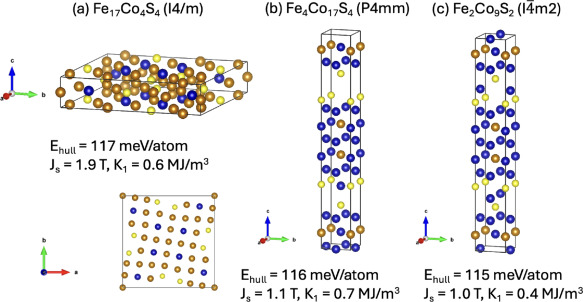
Fig. 14. Promising Fe–Co–S magnetic structures with hull energies 100 meV/atom. Fe, Co, and S atoms are indicated by brown, blue, and yellow spheres, respectively. Published in Journal of Magnetism and Magnetic Materials, May 15, 2026.*

The most recent chapter of Chelikowsky's career represents the kind of pivot that has defined it throughout. In 2025, he received the Hill Prize in Physical Sciences from the Texas Academy of Medicine, Engineering, Science and Technology and Lyda Hill Philanthropies, recognizing high-risk, high-reward research with real-world potential. The work had nothing to do with silicon. Instead, it pivoted to a different focus — using artificial intelligence to find entirely new magnetic materials. 

The practical problem is significant. Powerful magnets are used in electric vehicles, wind turbines, and medical devices, and rely on rare and expensive elements. Finding high-performance alternatives essential for high-tech and clean energy industries has been an important unsolved problem for years. Chelikowsky's group applied AI to search millions of candidate materials computationally, identifying promising compounds that no human researcher would have thought to investigate.  

"Rather than examining a handful of candidate materials, we can now explore millions of possibilities and uncover compounds that might never have been considered otherwise," he said. "AI is not replacing science; it is helping us ask better questions and explore far more possibilities than ever before." 

The connection to his earlier work on materials databases is not accidental. Long before AI-guided material discovery became a recognized field, Chelikowsky's group was assembling databases and applying data-driven methods to the field. He helped organize one of the first conferences devoted to the topic. The AI work of recent years is, in some ways, the fulfillment of ideas he was pursuing decades earlier. "What I find most exciting," he said, "is the shift from explaining known materials to discovering entirely new ones." 

Chelikowsky does not think of retirement as a hard stop. He plans to stay intellectually active, engaged with the field and with students, following developments as they unfold. What he hopes the next generation carries forward is less about a particular method and more about the approach behind research.  

"The most important advances come from new ideas," he said, "not just bigger computers or more data." AI will matter, he believes, but it will not be the last revolution. New tools always emerge. The challenge is knowing when they provide genuine scientific insight and when they are simply the latest trend. After six decades at the frontier, few are better positioned to make that distinction. 

*AI-driven and quantum-informed searches for rare-earth free magnets: Applications to Fe–Co–X (X=B, C, P, Si, S) compounds