University of Texas at Austin

News

Testing Treatments Before the Trials: Oden Researchers Build Virtual Clinical Trials for Breast Cancer

Published Oct. 16, 2026

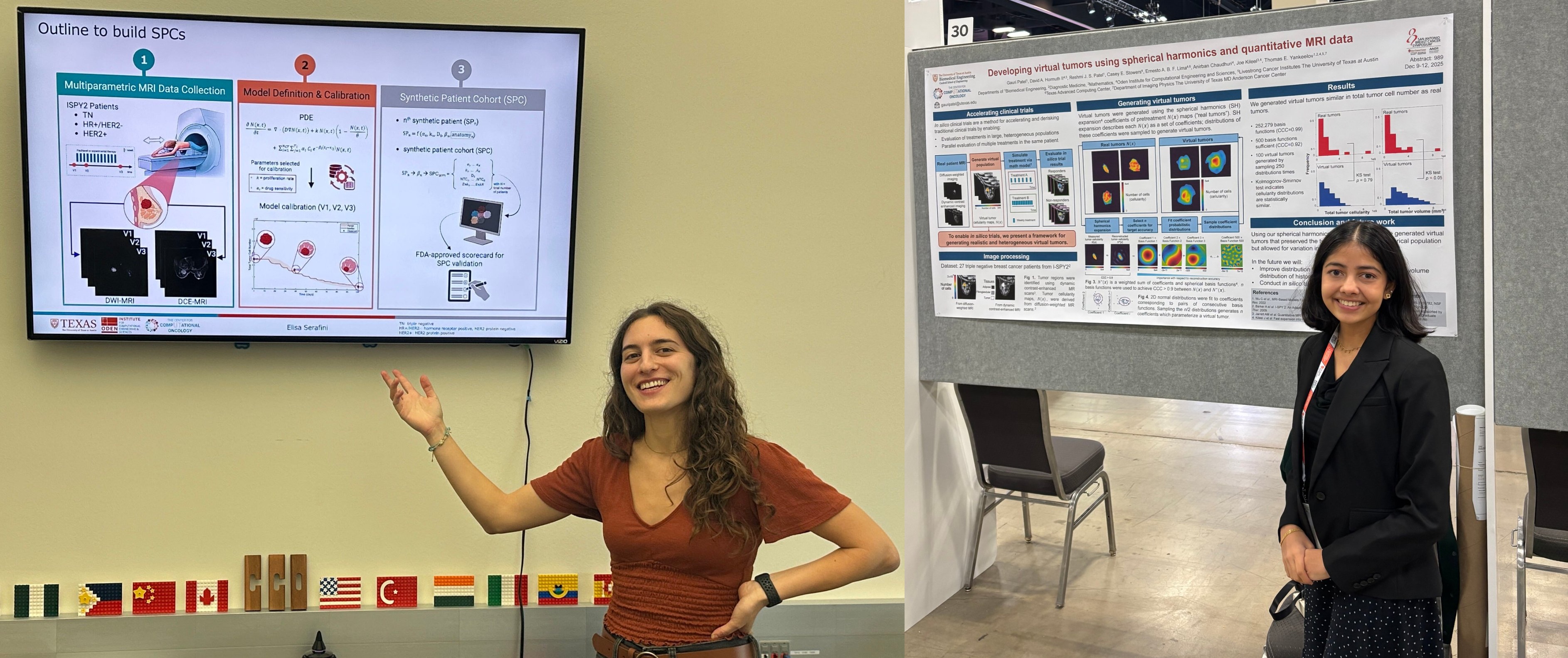
Elisa Serafini (left) and Gauri Patel (right) present their research on building synthetic breast cancer patients for virtual clinical trials. Credit: Elisa Serafini and Gauri Patel.

October is Breast Cancer Awareness Month. This year, the American Cancer Society estimates that more than 320,000 women in the United States will be diagnosed with invasive breast cancer, a disease that affects about 1 in 8 women over their lifetime. Every new therapy that reaches those patients must first pass through clinical trials. At the Oden Institute for Computational Engineering and Sciences’ Center for Computational Oncology (CCO) at The University of Texas at Austin, two researchers are working to make this process smarter by building virtual clinical trials. Virtual clinical trials are computer simulations that test how a treatment is likely to perform on large groups of "synthetic patients" before a real trial enrolls anyone.

Elisa Serafini, an Oden Institute Peter O'Donnell Jr. Postdoctoral Fellow, earned degrees in medical and biomedical engineering in Italy before completing a Ph.D. in applied mathematics through a joint program between La Rochelle University in France and the Houston Methodist Research Institute. Her graduate work combined computational models with experimental data to investigate bone metastases and their response to treatments. 

Gauri Patel, a Ph.D. candidate in the Department of Biomedical Engineering at UT, studied biomedical engineering at the University of Michigan, where she used image analysis to study how the arrangement of cells inside tumors shapes treatment outcomes. The two began working together in March 2026, Serafini joined the CCO, which is led by Tom Yankeelov, professor of biomedical engineering and Oden Institute principal faculty.

Together, they are modeling patients from the I-SPY2 breast cancer clinical trial to test whether these simulations can actually help researchers design real trials more efficiently. We spoke with them about how virtual trials work, what a synthetic patient is, and what success would look like.

Responses have been edited for length and clarity.

Q: What is a virtual clinical trial, and why do we need one?

Serafini: Traditional clinical trials are slow, expensive, and frequently unsuccessful. They require substantial infrastructure and funding, yet in oncology only 3 to 5 percent of drug candidates that enter Phase I ultimately receive FDA approval. Patient recruitment is a major bottleneck: nearly 80 percent of trials face enrollment delays, and roughly 20 percent fail to recruit enough participants to produce reliable results.

Virtual clinical trials, made possible by advances in mathematical and computational modeling, offer a complementary approach. Using computer-based simulation, researchers generate cohorts of synthetic patients that capture and go beyond the variability of real populations. They can then predict how a treatment is likely to perform before it reaches patients. The goal is to inform and refine the design of conventional trials, not to replace them. Virtual trials also make it possible to compare alternative regimens, such as different doses or schedules. Combined with optimal control theory, a mathematical framework for finding the best way to steer a system toward a desired outcome, virtual clinical trials can potentially identify treatment strategies that maximize benefit while minimizing toxicity.

Q: What exactly is a synthetic patient, and how do digital twins fit in?

Serafini: In general, a synthetic domain is a structured representation derived from real-world data but without a direct physical counterpart. This enables the study of larger and more representative groups, without being limited to physical observations alone. In our case, the synthetic domain is the breast cancer domain, and it is generated through hybrid techniques that combine data-driven, probabilistic, and mechanistic modeling. The term "patient" here refers to the breast tumor, but we use the more generic term to remain consistent with conventions in computational medicine.

Patel: Yes, digital twins are indeed a tool for developing virtual clinical trials. Generally, digital twins are mathematical representations of patient information with three key abilities: they are iteratively updated with new patient data, they can predict a patient-specific response to treatment, and they can inform treatment decisions toward a desired outcome. Previous efforts in our lab have validated a digital twin model for breast cancer chemotherapy that Elisa and I are using to simulate treatment in our synthetic breast cancer patients. To be clear, synthetic patients aren't digital twins. They rely on the same mathematical modeling that digital twins require, but they don't have a one-to-one correspondence with real patients, which means they can extend beyond the observed data and be the desired cohort to run a virtual clinical trial.

Q: What are you focusing on in breast cancer specifically?

Serafini: October is Breast Cancer Awareness Month, so Gauri and I are particularly grateful to have the opportunity to speak about our work. We are modeling patients from the I-SPY2 clinical trial, which includes three cancer subtypes and multiple chemotherapy treatment arms. We generated synthetic populations using two different generative mechanisms, comparing how each technique offers different and complementary insights. We are now assessing the quality of each synthetic dataset using the FDA's scorecard for synthetic medical data. Once we have a consolidated synthetic cohort, we will run a virtual clinical trial to test whether simulation can improve sample size estimation and patient arm assignment and help guide the design of in-person clinical trials.

Patel: I am focused specifically on triple-negative breast cancer, while Elisa works more broadly on multiple breast cancer subtypes: triple-negative, HR+/HER2-, and HER2+. In principle, our methods should generalize to other solid tumors.

Q: How will you know if this works, and what do you hope it leads to?

Patel: In the short term, success will be demonstrated if we can show that our synthetic patient cohorts can recreate the results of historical clinical trials. By recreating past results, we can have confidence in the results of our virtual clinical trials, where we would test novel treatment regimens on synthetic populations.

In the long term, we hope our work and similar efforts can provide a compelling case to regulatory bodies that virtual clinical trials are a necessary tool to de-risk and accelerate traditional clinical trials. Increasing the number of drugs that reach FDA approval, and are thus available to patients, is an important part of treating a disease as heterogeneous as cancer. Virtual clinical trials can provide interpretable and actionable results that don't come with the same feasibility obstacles as traditional trials.

Q: How does being at the CCO and the Oden Institute support your research?

Serafini: Being part of the CCO and the Oden Institute directly accelerates each stage of our work. Under the guidance of Drs. Yankeelov and Hormuth, we benefit from the group's extensive experience in mathematical oncology and its established work with breast cancer data. Our close collaboration with physicians and researchers at MD Anderson Cancer Center keeps our synthetic cohorts and virtual trial designs grounded in clinical reality and gives us expert feedback on whether our results are meaningful for patient care. The Texas Advanced Computing Center (TACC) gives us the computational power to run large numbers of virtual trial simulations, work that would be impractical on standard resources. Finally, the Joint Center for Computational Oncology (JCCO) brings together expertise in modeling, clinical oncology, and high-performance computing around a shared "simulation first" vision for personalized cancer care, the same vision that motivates our work.