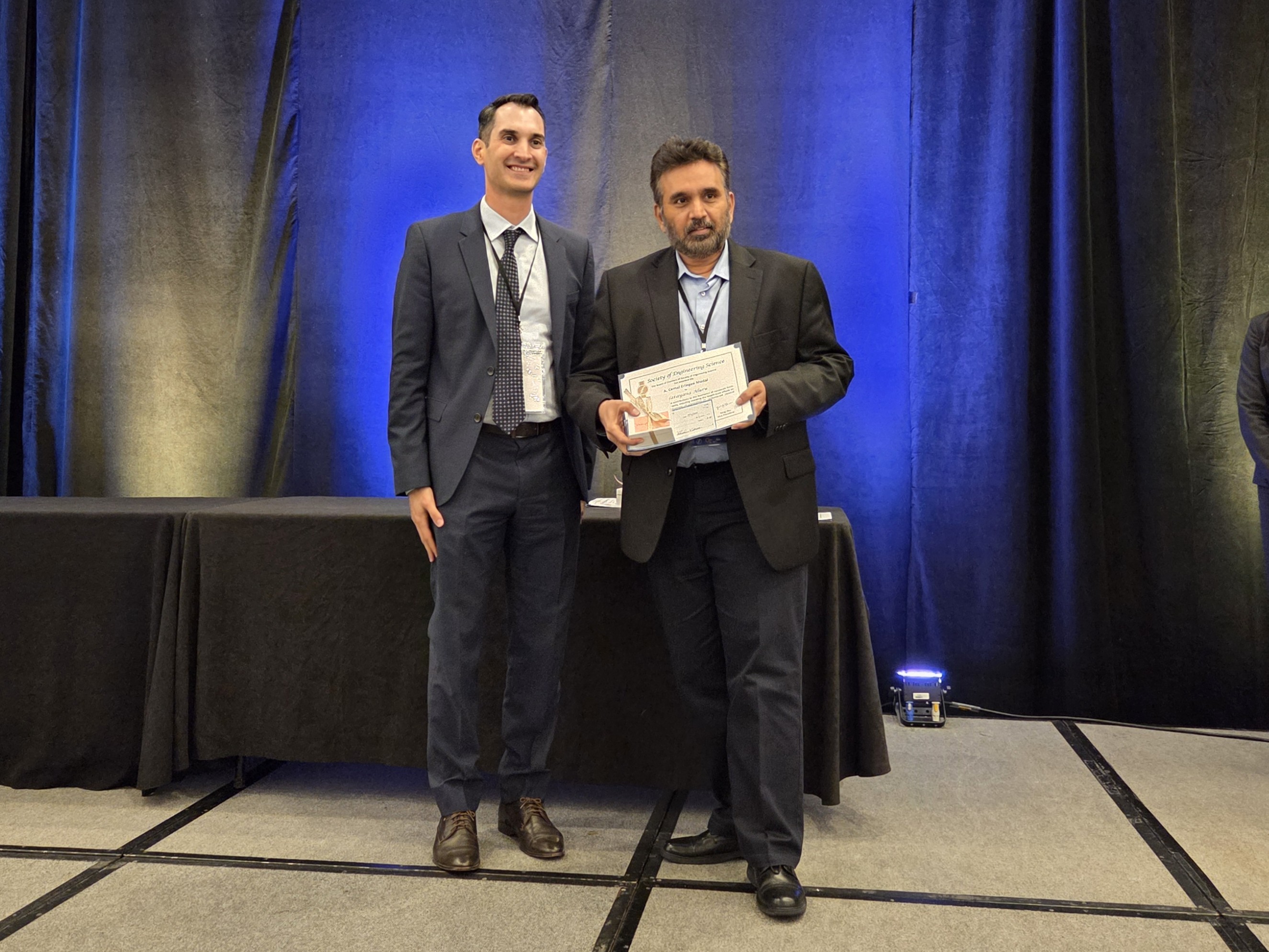
For over two decades, Narayana Aluru has been quietly pioneering the field of nanofluidics, developing the foundations of a promising field that could desalinate water and generate immense power. A principal faculty member at the Oden Institute for Computational Engineering and Sciences and a professor at the Walker Department of Mechanical Engineering at The University of Texas at Austin, Aluru was recognized at the annual Society of Engineering Science (SES) meeting in October where he was awarded the prestigious A.C. Eringen Medal for innovative research.
Named after the founder of SES, the prize is presented annually to one scientist who has sustained and outstanding achievements in engineering science. Recipients of the medal are nominated and selected by their fellow SES peers — a process that suits Aluru’s humility, as he would never seek recognition himself. Although he knew a former student had nominated him, Aluru was still utterly shocked when he learned he had won. “I’m not so much into awards,” he muses. “I just like to do great science, so it is always gratifying if the community thinks that I am doing good.”
To say Aluru is doing good is an understatement. Twenty-five years ago, while studying microfluidics, he noticed the untapped potential of nanofluidics. Nanofluidics — the physics of fluids in extreme confinement, typically at nanometer and sub-nanometer scales — was not well understood at the time. So, he plunged into the unexplored terrain of nanofluidics and established the foundations of the new field, developing fundamental theories and computational methods grounded in experimental observation.
Despite being tiny phenomena, nanofluidics could solve some of the biggest global challenges. For example, he investigated a nanoporous membrane called molybdenum disulfide to separate water from ions, producing drinking water from seawater. Furthermore, he showed we could capitalize on the osmotic pressure difference between fresh water and seawater to generate renewable energy using this same material. As fossil fuels and freshwater sources become scarcer, his research is poised to confront these challenges head-on.
Explaining this research, Aluru gave the Eringen Medal Lecture during the SES annual meeting. The talk, titled “Molecules in Extreme Confinement: From Foundational Mechanics to Ionic Memory,” introduced why nanofluidics behave differently from macroscale fluids, highlighted the distinctive properties they have, discussed the theories that predict such behaviors and properties, and finally closed with the aforementioned applications of his research.
Aluru is no stranger to receiving awards. Even though he shies away from the limelight, the well-deserved A.C. Eringen medal adds to his lengthy list of accolades, confirming the impact of his research.
“It means a lot to me,” Aluru said about sharing the accolade with two Oden Institute colleagues. Previously, Thomas J.R. Hughes, principal faculty member at the Oden Institute, won the award in 2020, and the late J. Tinsley Oden, the namesake of the institute, won in 1989. “Tinsley and Tom are people whom I have admired all my life, starting from graduate school days. Seeing those two win it and now being the recipient of this award is deeply humbling.”
In true Aluru fashion, he generously treated colleagues and former students who presented at the Eringen Medal Symposium to dinner the night before his celebratory banquet with the proceeds from the prize. Like the nanoscale systems he studies, Aluru’s unassuming presence continues to shape the world in powerful, often hidden ways.
Announced in 2024, the award was officially presented during the annual conference held Oct. 12 - 15, 2025, in Atlanta, GA.