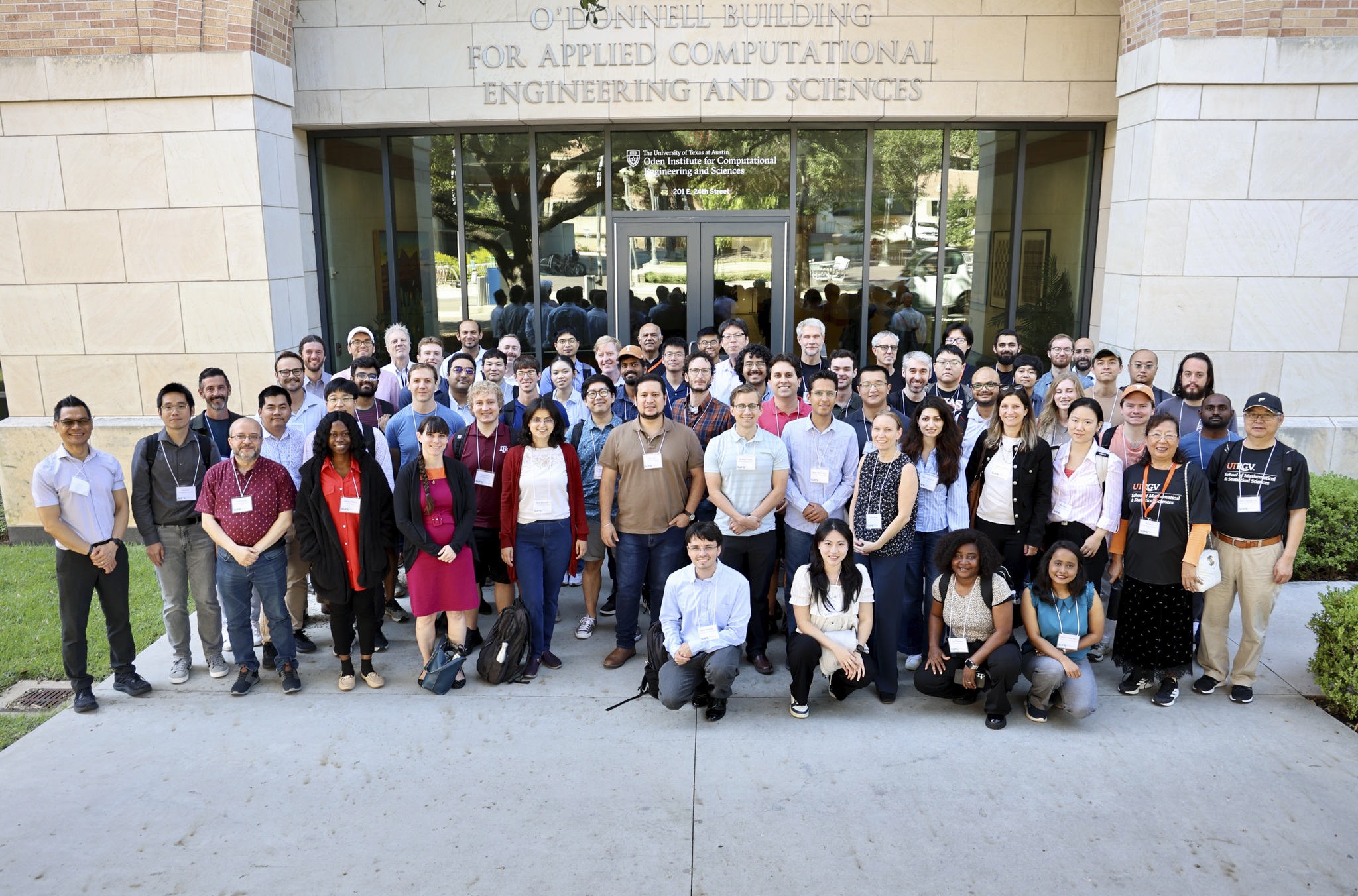
The 2025 Scientific Machine Learning Workshop (SciML), hosted annually by the Oden Institute for Computational Engineering and Sciences at The University of Texas at Austin, brought together researchers, students, and industry collaborators for two days of talks and poster sessions that were focused on AI-powered approaches to complex scientific problems. This year’s event, held on Sept. 25 - 26, centered around a focused theme: Scientific Machine Learning for Differential Equations.
According to event organizer Tan Bui-Thanh, professor of aerospace engineering and engineering mechanics and head of the Probabilistic and High Order Inference, Computation, Estimation, and Simulation Group at the Oden Institute, the decision to narrow the scope of the third annual conference led to “a great sample of the community coming together to exchange ideas and learn from each other.” With attendees ranging from applied mathematicians to engineers from around the world as well as national lab scientists, the event fostered an environment for deep conversation around theory and computation, as well as real-world applications of machine learning in scientific domains.
“This year’s theme really resonated with a large number of registrants and resulted in strong attendance through the final talk,” Bui-Thanh noted.
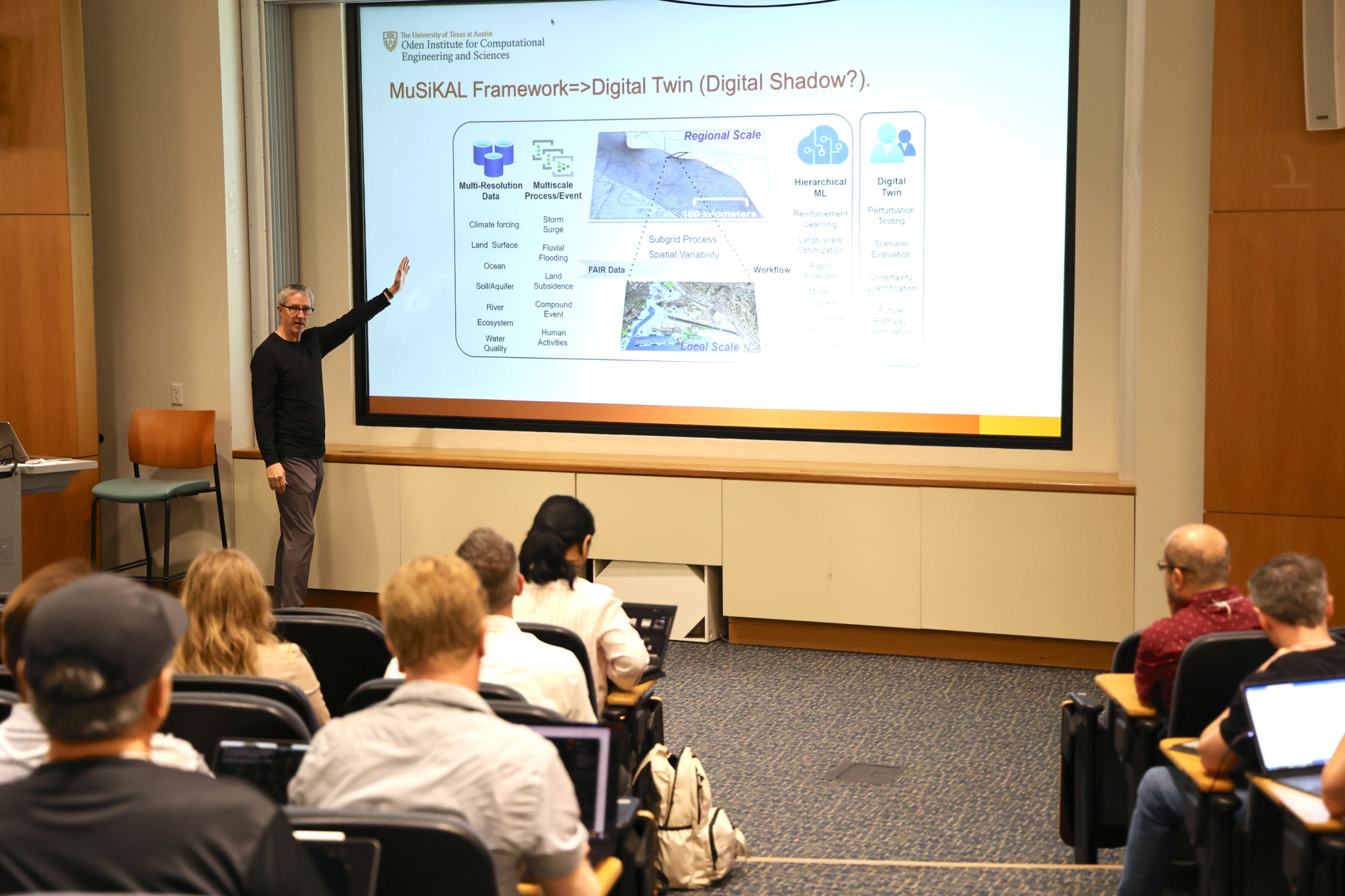
UT’s Clint Dawson was among the more than 17 presentations over the two-day workshop. Dawson’s talk on coastal storm surge modeling demonstrated how machine learning algorithms are being used in practical applications. Dawson, professor of aerospace engineering and engineering mechanics and head of the Computational Hydraulics Group at the Oden Institute, said his research team is developing a dynamic digital twin of the coastline. This model would continuously adapt to real-time data, offering a powerful tool for predicting and responding to coastal hazards in areas where a significant portion of the U.S. population resides that are especially vulnerable to tropical systems.