University of Texas at Austin

News

Where Earth Science Meets Artificial Intelligence: Inside the HydroML Symposium

Published July 3, 2026

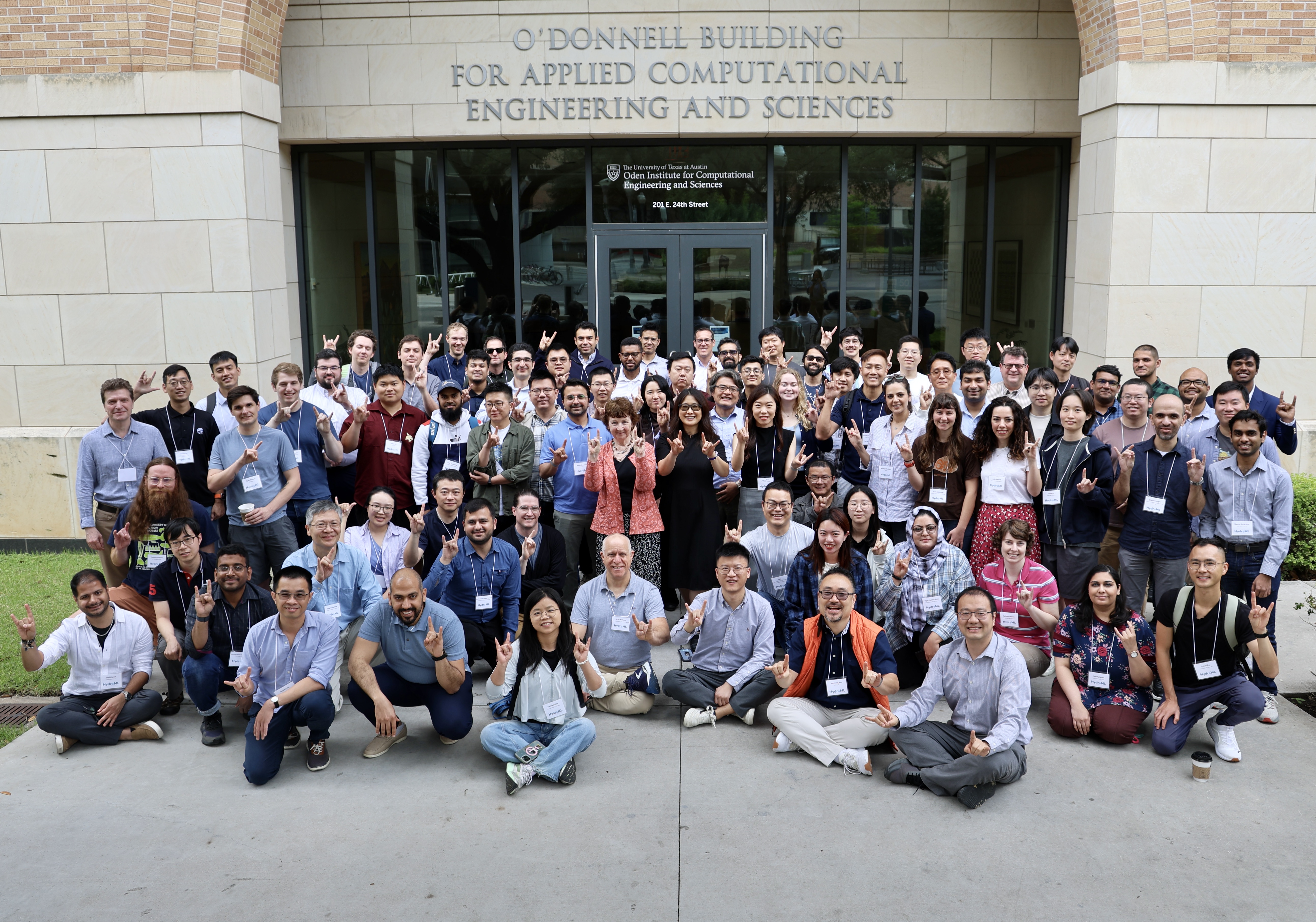
2026 HydroML Attendees. Credit: Joanne Foote/Oden Institute

More than 120 researchers from across the country and around the world gathered in May at The University of Texas at Austin for the fifth HydroML Symposium, a three-day meeting that brought together researchers working at the intersection of artificial intelligence and machine learning in water and Earth sciences. This year's event was hosted by UT’s Oden Institute for Computational Engineering and Sciences and the Jackson School of Geosciences, bringing domain science and computational methods into closer conversation.

Hydrological systems are genuinely complex. Water moves across land surfaces, percolates through subsurface geology, and interacts with climate and vegetation in ways that are difficult to capture with traditional physics-based models alone. Data gaps, regional variability, and the scale of these systems all create challenges leading researchers to explore how machine learning can help. As the world's water supply grows more unpredictable — through both the overabundance or lack of water — floods, droughts, and storm surges — the need to better understand water and Earth systems only increases. 

This is where HydroML and the partnership between geosciences and computational science comes into play. At UT, the Jackson School brings Earth science expertise, including knowledge of how these systems behave, what observations are meaningful, and what the models need to capture. The Oden Institute contributes the mathematical and computational tools, including machine learning frameworks and high-performance computing simulation, to extend what those models can do. 
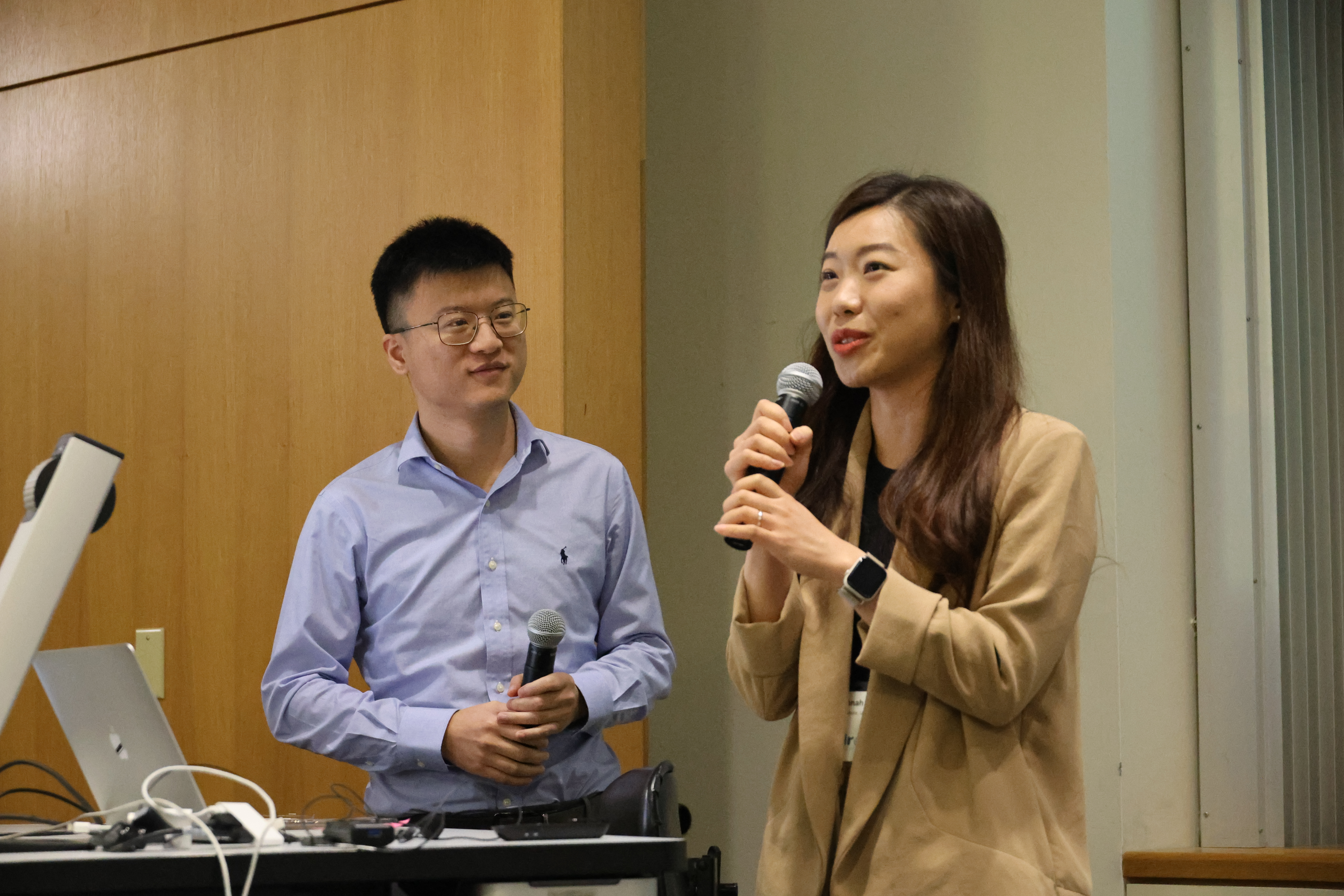
block.caption

Dapeng Feng and Hannah Lu. Photo credit: Julia Sames/Jackson Schoolof Geosciences

Michael Young, Jackson School associate dean for research, noted the fit in his opening remarks at the event.

"It's really exciting this symposium is hosted here at UT Austin, especially given the rapid development of AI/ML uses that we read about every day in the news, and the amazing research and development that spans the Jackson School and Oden Institute," he said.

The symposium was organized by two early-career faculty whose appointments reflect this kind of cross-institutional work. Dapeng Feng, an assistant professor of Earth and Planetary Sciences at the Jackson School, focuses on physics-informed machine learning for hydrology. Hannah Lu, an assistant professor in aerospace engineering and engineering mechanics and core faculty member at the Oden Institute, brings computational and mathematical expertise to Earth systems problems. Their co-leadership of the event was itself a working example of the collaboration the symposium promotes.

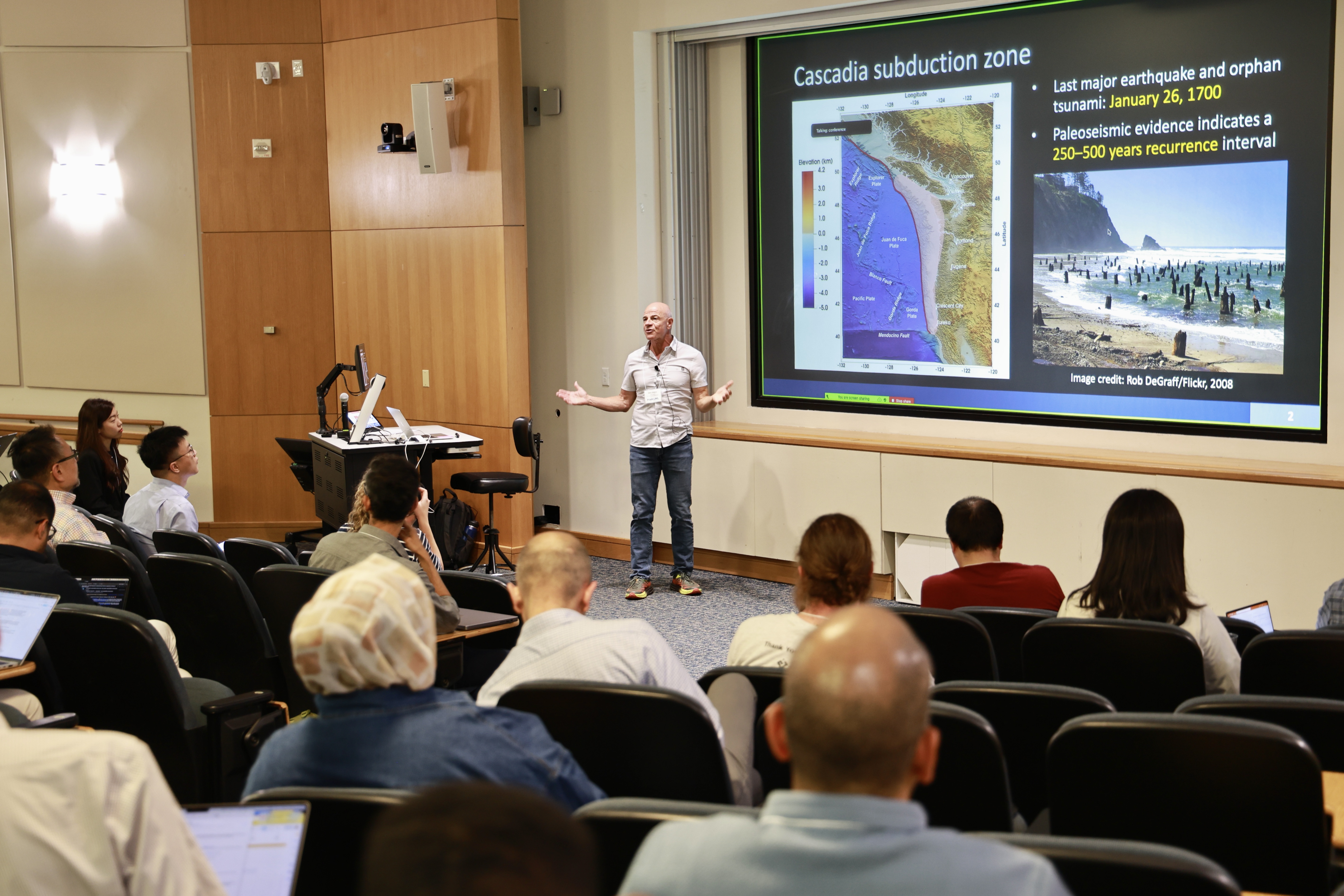
The symposium featured 35 science talks, two panel discussions, 40 poster presentations, and five keynote addresses. Day one focused on Earth systems and extreme events, with talks on using AI to predict tsunamis, model glacier terminus retreat, and forecast floods — areas where machine learning is being applied to problems that have historically been difficult to model with sufficient accuracy or speed.

We're in the midst of a paradigm shift, and it's going to be really interesting to see what's possible in the next five years.

— Martyn Clark, University of Calgary

Day two moved into methodology. Feng presented on why integrating physics into machine learning models matters for hydrology — a question central to the field, since models grounded in physical laws tend to be more reliable and interpretable than purely data-driven approaches. A session on hybrid AI modeling explored how computational methods can work alongside established physical frameworks rather than replacing them.

Bridget Scanlon, research professor with the Jackson School's Bureau of Economic Geology, gave a keynote on the opportunities and challenges of applying machine learning to hydrology. Daniel Tartakovsky, professor of energy science engineering at Stanford University, addressed a practical constraint common in Earth sciences: sparse data. His talk explored how machine learning can remain useful, and needs to be carefully applied, when observational records are limited.

Rounding out the keynote slate was Omar Ghattas, professor of mechanical engineering and principal faculty member at the Oden Institute, and Brian Freitag, NASA physical scientist, who gave perspectives on large-scale Earth observation and computational simulation.

block.caption

Omar Ghattas. Credit: Joanne Foote/Oden Institute

The symposium closed with a keynote from Martyn Clark, professor at the University of Calgary, who reflected on where the field is headed.

"We're in the midst of a paradigm shift, and it's going to be really interesting to see what's possible in the next five years," he said.

The HydroML Symposium has become a reliable gathering point for researchers in these combined fields. Hosting it jointly reflects a recognition that progress in water and Earth sciences and AI/ML depends on interdisciplinary experts working together.